Translated by ChatGPT. Find the full review (German with subscription) HERE
The Iranian-Israeli band Sistanagila gives a moving concert with the Württembergische Philharmonie in Reutlingen’s Stadthalle
By Jürgen Spiess
REUTLINGEN
Sistanagila is one of those bands whose members come from very different backgrounds. Their names reflect the diversity: Jewish, Iranian and Israeli identities come together in this group. Their musical forms would probably be difficult to categorize as simply Iranian or Israeli, because geographically and linguistically they are too far apart. But this is precisely where the group’s strength lies: they combine different traditions and cultures.
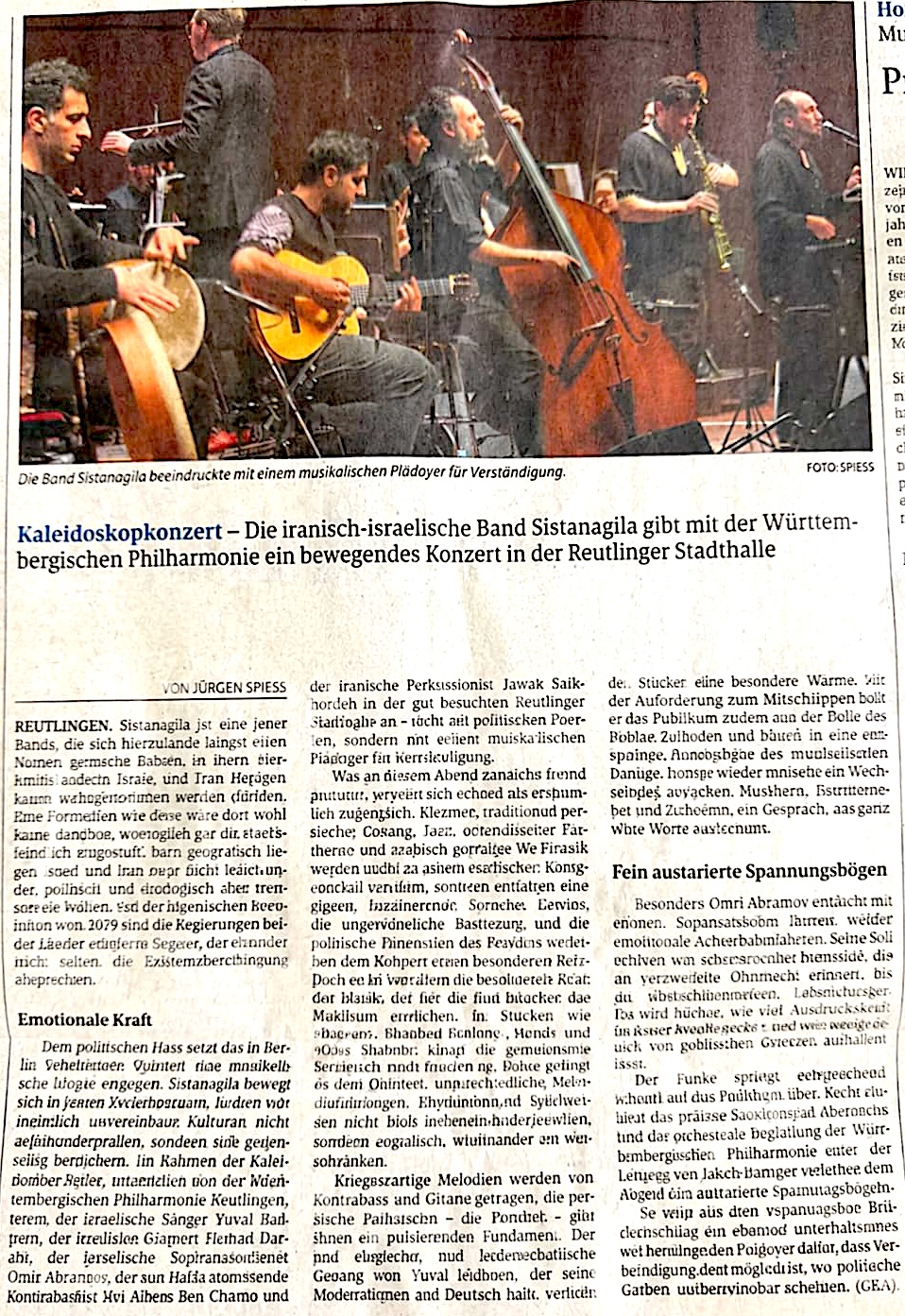
In the context of the Kaleidoscope Concert of the Württembergische Philharmonie Reutlingen, the Israeli singer Yuval Halpern, the Israeli soprano Omri Abramov, the Iranian percussionist Jawad Salkhordeh and the ensemble’s other musicians created an extraordinary musical experience for a well-attended audience in Reutlingen’s Stadthalle.
Emotional power
The music of Sistanagila is set against political hatred with an artistic counterpoint. The band moves between different cultural worlds without allowing them to clash; instead, they complement one another.
As part of the Kaleidoscope Concert series of the Württembergische Philharmonie Reutlingen, the Israeli singer Yuval Bal-Abut, the Israeli soprano Omri Abramov, the Iranian percussionist Jawad Salkhordeh and other musicians came together.
Despite the politically charged background, the evening developed into something that was initially unfamiliar but gradually became accessible. Klezmer, traditional Persian music, jazz, Oriental and Arabic sounds entered into a fascinating musical dialogue.
The musicians created an extraordinary mixture of musical colors and textures. In pieces such as [the article names several pieces], the combination of the different musical traditions produced something that seemed to transcend their origins.
Particularly striking was the way the music brought together the contrasting worlds represented by the musicians. The sound was not presented as a political statement in the conventional sense, but as an encounter between people and musical cultures.
Omri Abramov, in particular, impresses with his emotional expressiveness and exceptional musicianship. His playing creates a wide range of moods, moving from moments of deep melancholy to passages of greater intensity.
The music ultimately becomes a plea for understanding — not through political speeches, but through musicians listening to one another and creating something together.